Showing posts with label germany. Show all posts

Saturday, April 12, 2008

UConn prof writes clear PBMR overview


Pelindaba, South Africa, pebble bed work site

Professor Lee Langston writes in Mechanical Engineering
University of Connecticut retired professor Lee Langston has just published a very clear, readable history of the pebble bed modular reactor project underway in South Africa. Pebbles Making Waves is the feature article in the April, 2008, issue of Mechanical Engineering, published by the American Society of Mechanical Engineers.

I encourage you to read this overview of the history and status of the Pebble Bed Modular Reactor project in South Africa.


Wednesday, March 19, 2008

Pebble fuel grains pass performance testing


INL Advanced Test Reactor test site

An earlier post described the start of testing of the multiple-layer-coated fuel grains that form the billiard-ball-sized fuel pebbles in the pebble bed reactor. Idaho National Laboratory used its Advanced Test Reactor to expose these test fuel grains to radiation levels much higher than in an operational PBR, thus simulating years of exposure in a few months. The multiple, coated layers of silicon carbide and ceramic graphite contain the radioactive products of fission. These tested fuel grains have not failed, at the level of 9% burn-up of the uranium within. Tests will continue to see if a 12-14% burnup can be achieved by year-end.

Saturday, April 7, 2007

Germany built the first pebble bed reactor


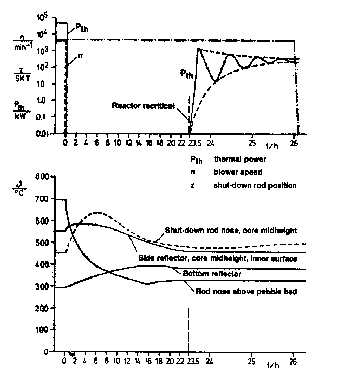
Demonstration of inherently safe AVR shutdown

The pebble bed reactor is an intrinsically safe because the chain reaction diminishes as the fuel temperature rises. This has been demonstrated. The experimental Arbeitsgemeinschaft Versuchsreaktor (AVR) was built in Germany in 1960. Dr. Rudolf Schulten was the originator of the pebble bed reactor design. The experimental AVR at the Julich Research Center operated at 46 megawatt thermal power, about 13 negawatt electric. The safety test was performed in 1970 by stopping the cooling and preventing the control rods from activating. The temperature rose, Doppler broadening absorbed neutrons in U238, the chain reaction slowed, temperatures fell, and the unit stabilized at 300 kilowatts.


HTR-300 Cooling Tower

Germany also built a second pebble bed reactor, the THTR-300, which generated 300 megawatts when it achieved full power operation in 1989. THTR stands for Thorium High Temperature Reactor; it uses thorium to enrich the uranium fuel. Thorium is fertile in that it is not itself very radioactive but can be transformed into uranium fuel. The Th232 absorbs a neutron from the chain reaction of U235 decay, and then the Th233 decays into U233, which is a fissile element that participates in the chain reaction. Thorium is three times as plentiful as uranium in the earth's crust.

In 1986 an operator error caused some of the pebbles to be fractured and the helium gas lock to be jammed. An unknown amount of radioactive materials were released. The THTR-300 was shut down in 1989 following public concerns arising from the Chernobyl accident. Since then Germany has decided to shut down all its nuclear power plants.