Saturday, August 4, 2012

THORIUM: energy cheaper than coal

THORIUM: energy cheaper than coal is a new book about two energy technologies that can solve global warming, sustainability, and energy poverty. Energy cheaper than coal is the only realistic way to dissuade 7 billion people in 250 countries from burning coal to make electricity. Thorium and the molten salt reactor provide the means to manufacture liquid fluoride thorium reactors (LFTR) at a price that will undercut coal, economically.

Those who still admire the pebble bed reactor may find attraction in a variant, the molten salt cooled pebble bed reactor, described in the book.


Wednesday, March 24, 2010

US Dept of Energy saves pebble bed reactor project

South Africa Pebble Bed Modular Reactor

South Africa's Pebble Bed Modular Reactor company has been thrown a $10-million lifeline by the US Department of Energy only a week before its government funding runs out.

But it will not be enough to prevent the retrenchment of three-quarters of the PBMR's 800 staff and the reduction of its executive team from 11 to three. CEO Jaco Kriek resigned earlier this month and other executives are expected to follow.

Minority investor Westinghouse is said to be mulling a further investment.

PBMR has already suspended development of the triple reheat Brayton cycle helium turbine that would achieve the high thermal/electrical power conversion efficiency. Many had hoped this research would be transferable to other high temperature gas cooled reactor projects.


Friday, February 20, 2009

Aim High -- Thorium energy cheaper than from coal


Liquid Fluoride Thorium Reactor

The liquid fluoride thorium reactor is another advanced nuclear power source, even more promising than the pebble bed reactor. The LFTR uses inexpensive thorium as a fuel, transforming it to uranium-233 which fissions, producing heat and electric power at a cost less than that from coal power plants.

Thorium and uranium are dissolved in molten salt, simplifying fueling and waste removal compared to today's nuclear power plants. Prototype molten salt reactors were developed and tested by the US at Oak Ridge National Laboratories in the 1960s and 1970s. In 2006 the Oak Ridge research papers were scanned and posted on the internet. A collaboration of scientists, engineers, and professional volunteers has begun developing an updated conceptual design for the LFTR.

Aim High

Aim High is a proposal to factory-produce 100 MW electric power reactors to achieve an electric power cost cheaper than from coal. By economically undercutting coal power plants we can dissuade India, China, and the other developing nations from burning coal, without carbon taxes, which they would never accept. Less expensive, affordable electric power is also key to helping the developing nations achieve a modest level of prosperity that leads to population stability.

The Aim High book is available at Amazon. The Aim High website contains a Power Point version of the proposal and more information. The Energy From Thorium website contains an extensive blog, forum, and reference library.

PBMR to run out of cash in 2010


Conceptual layout of a PBMR
Johannesburg's Business Report says the pebble bed modular reactor project is running out of cash. It's initial goals may have to be redirected.

One way to obtain an early benefit from the PBMR is to use its heat directly, deferring the development of the helium turbine and electric generator. South Africa's SASOL company is the largest producer of gasoline from coal. The heat to drive the conversion also comes from coal, leading to increased CO2 emissions. The PBMR heat can be used instead, lowering CO2 emissions. Such process heat could also be used for extracting oil from the Canadian tar sands. Hyperion Power is also exploring this use for its uranium hydride reactor technology.

Saturday, April 12, 2008

UConn prof writes clear PBMR overview


Pelindaba, South Africa, pebble bed work site

Professor Lee Langston writes in Mechanical Engineering
University of Connecticut retired professor Lee Langston has just published a very clear, readable history of the pebble bed modular reactor project underway in South Africa. Pebbles Making Waves is the feature article in the April, 2008, issue of Mechanical Engineering, published by the American Society of Mechanical Engineers.

I encourage you to read this overview of the history and status of the Pebble Bed Modular Reactor project in South Africa.


Wednesday, March 19, 2008

Pebble fuel grains pass performance testing


INL Advanced Test Reactor test site

An earlier post described the start of testing of the multiple-layer-coated fuel grains that form the billiard-ball-sized fuel pebbles in the pebble bed reactor. Idaho National Laboratory used its Advanced Test Reactor to expose these test fuel grains to radiation levels much higher than in an operational PBR, thus simulating years of exposure in a few months. The multiple, coated layers of silicon carbide and ceramic graphite contain the radioactive products of fission. These tested fuel grains have not failed, at the level of 9% burn-up of the uranium within. Tests will continue to see if a 12-14% burnup can be achieved by year-end.

Tuesday, March 4, 2008

Energy Policy and Environmental Choices: Rethinking Nuclear Power


Will the public rethink nuclear power?

I have not posted anything to this blog about pebble bed reactors for months. I have been busy developing a way to educate the general public about the broader issues of nuclear power.

Most people to whom I have presented the pebble bed reactor have been encouraging and supportive. The most common query I receive is "what about the waste?".

I now think public acceptance of nuclear power will depend on reprocessing to burn up the most hazardous radioactive waste. Also, reprocessing will wondrously provide a century of power just from the existing spent fuel inventories at nuclear power plant sites. Not only can non-fissile U-238 be bred into plutonium fuel, but abundant thorium can also be bred into U-233 fuel. We can have fuel that meets all our energy needs for thousands of years and waste that decays in a few hundred.

I have tried to rethink the advantages and disadvantages of pebble bed reactor technology. which I summarize below.

ADVANTAGES
  • Passive safety makes core meltdown impossible.
  • Modularity allows smaller plants, with less capital investment risk, and distributed siting.
  • Small size permits factory mass production and on-site assembly.
  • High temperature, air cooled reactor needs no water for cooling.
  • 50% efficiency means 2/3 the fuel use.
  • High temperature permits direct hydrogen production.
  • Multi-layer pebbles containing all reaction waste products are ready for burial.

DISADVANTAGES
  • Technology learning curve not yet fully traversed.
  • Licensing in the US will require new NRC skills and knowledge.
  • US needs more nuclear power now, from already approved designs.
  • Fuel supply will be strained at the proposed one-unit-per-week installation schedule.
  • Reprocessing fuel in the hard pebbles will be difficult.

DARTMOUTH COLLEGE ILEAD
ENERGY POLICY AND ENVIRONMENTAL CHOICES:

RETHINKING NUCLEAR POWER

This is an 8-week course developed for the Dartmouth Ilead continuing education department. The course meets 2 hours a week beginning March 31, 2008, at Dartmouth College in Hanover NH. More information is available at http://rethinkingnuclearpower.googlepages.com.

The PowerPoint slides and audio of the talks will be posted after each session.

Syllabus

Global warming continues. The world consumes oil and gas faster than finding it. We import oil from unstable countries. Producing ethanol from corn consumes almost as much energy as the ethanol delivers. Sites for wind and hydro power are limited. Can more nuclear power help? Are the health risks acceptable? One theme will be how many? How many acres of corn? How many power plants? How many windmills? How many tons of uranium? How many tons of CO2?


1. Introduction

Energy units, uses, sources
Social benefits, demand growth, conservation, developing world
Periodic table, nuclear fission, nuclear power plants

2. Fear

Chernobyl, Three Mile Island
Radiation, health, safety, waste
Nuclear weapons proliferation

3. Environmental choices

Oil and gas depletion
Global warming, mining, coal, oil shale, tar sands
Wind, hydro, solar
Corn, sugarcane, cellulosic ethanol, biodiesel
Uranium and thorium availability

4. Current technology

Submarines and ships
Operating nuclear power plants, industry structure, NRC
Current products: GE, Westinghouse, Toshiba, Areva

5. Nuclear power plant visit

Vernon

6. New technologies

High temperature gas reactors, liquid metal reactors
Hydrogen production, hydrocarbon synthesis, coal-to-liquid, electric cars

7. Global Nuclear Energy Partnership

Integral fast reactor, waste reprocessing
Fuel supply for non-nuclear nations
Current public awareness, funding, activities

8. Debate

Antinuclear activism, Union of Concerned Scientists, Caldecott
Public opinion, NEI, environmentalist shifts
Congressional and presidential candidate's views

Friday, April 13, 2007

Nuclear powered cars are emissions free

or or
Some ways to generate electricity for electric cars

Electric cars are emissions free, unless the electric power they use comes from coal power plants. Electric cars are becoming available, and more are planned.


2010 Chevrolet Volt Electric Vehicle

Chevrolet will produce the Volt EV in the 2010-2012 time frame. It is powered by electricity from batteries that will allow the car to travel 40 miles on a single overnight charge. It also has a range extending internal combustion engine designed to run on gasoline, E85, or biodiesel fuels. The engine will give the drivers the confidence to venture out in a electric car, knowing they can drive even if the batteries run out. The turbo-charged three-cylinder engine provides 71 hp, and the electric motor can provide 161 hp. If you commute only 40 miles a day you can save 500 gallons of gasoline a year, saving $1200 after netting out the cost of electricity against $3 gasoline.


2008 Tesla Roadster Electric Car

This sports car can do 0-60 in about 4 seconds. Tesla Motors estimates 250 miles per charge, at a cost for electricity of about 1 cent per mile. Costing $92,000 it will not attract enough consumers to solve the US energy crisis, but it will be fun to drive.


2007 Toyota Prius plug-in hybrid shown to Bush

Consumers can today buy aftermarket conversion kits and batteries to allow cars such as the Toyota Prius to travel 20 miles on electric power alone. California is leading the nation in promoting plug-in hybrid vehicles.


Buying Nuclear Power for Cars

Originally conceived to lower energy costs through competition, electric deregulation has allowed consumers the choice of energy suppliers, and many choose "green" sources like wind power, or cow power (methane generated). Consumers pay a premium of about $0.04 per kilowatt-hour.

"Inconvenient Truth" Al Gore was criticized for the high energy consumption at his residence mansion, but his retort was that all his energy was purchased from "green" sources, so that he was not contributing to global warming. Providing a nuclear power purchasing option can similarly benefit the nuclear power industry, particularly if some electric vehicle fleets could be promoted as using clean, safe nuclear power.

I'd like to drive a car with a "Nuclear Powered" sign. Consumers today can not choose nuclear power. Nuclear power plant operators should file the necessary tariffs and enter into contracts with distribution utilities so that a consumer could indeed buy nuclear power for recharging his vehicle.

Melt-down-proof pebble bed reactors may be the power source for the future US automobile fleet.

Saturday, April 7, 2007

Germany built the first pebble bed reactor


Demonstration of inherently safe AVR shutdown

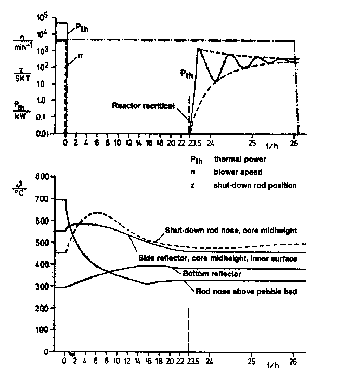
The pebble bed reactor is an intrinsically safe because the chain reaction diminishes as the fuel temperature rises. This has been demonstrated. The experimental Arbeitsgemeinschaft Versuchsreaktor (AVR) was built in Germany in 1960. Dr. Rudolf Schulten was the originator of the pebble bed reactor design. The experimental AVR at the Julich Research Center operated at 46 megawatt thermal power, about 13 negawatt electric. The safety test was performed in 1970 by stopping the cooling and preventing the control rods from activating. The temperature rose, Doppler broadening absorbed neutrons in U238, the chain reaction slowed, temperatures fell, and the unit stabilized at 300 kilowatts.


HTR-300 Cooling Tower

Germany also built a second pebble bed reactor, the THTR-300, which generated 300 megawatts when it achieved full power operation in 1989. THTR stands for Thorium High Temperature Reactor; it uses thorium to enrich the uranium fuel. Thorium is fertile in that it is not itself very radioactive but can be transformed into uranium fuel. The Th232 absorbs a neutron from the chain reaction of U235 decay, and then the Th233 decays into U233, which is a fissile element that participates in the chain reaction. Thorium is three times as plentiful as uranium in the earth's crust.

In 1986 an operator error caused some of the pebbles to be fractured and the helium gas lock to be jammed. An unknown amount of radioactive materials were released. The THTR-300 was shut down in 1989 following public concerns arising from the Chernobyl accident. Since then Germany has decided to shut down all its nuclear power plants.

Friday, March 30, 2007

China has built a pebble bed reactor


HTR-10 at China's Tsinghua University

China's Tsinghua University has built a 10 MW research pebble bed reactor, achieving criticality in 2000. HTR-10 stands for High Temperature gas-cooled Reactor of 10 Megawatts heat output. It is cooled by helium gas. The helium gas today powers a steam generator. Currently the faculty and students are designing a power conversion unit to be driven directly by the hot helium. This unit will incorporate helium compressors and turbines with active magnetic bearings and a compact heat exchanger.

Tsinghua University and MIT collaborate on the development of this pebble bed reactor.

Australia exports uranium to China. The Australian Broadcasting Company recently interviewed Professor Zhang Zuoyi about the HTR-10 pebble bed reactor in China. During the visit the reactor helium cooling system was purposefully shut down to demonstrate the intrinsic, passive safety of the pebble bed reactor. You can see this on the video available on the ABC web site.


Demonstration plant for 19 pebble bed reactors

China has ambitious plans for pebble bed reactor nuclear power. According to MIT Professor Andrew Kadak China will build a 190 megawatt demonstration reactor power plant at Rongcheng. If successful, a total of 19 pebble bed reactors generating 3,600 megawatts will be constructed at that site.

China is not just waiting for pebble bed reactor nuclear power. China already operates 10 nuclear power reactors, with 7 under construction. Additionally China just signed a $6-7 billion contract with Westinghouse to build four AP-1000 advanced pressure water reactors generating 1,000 megawatts each. [This works out to $1,360 per kilowatt capital cost, below the design goal of the US NGNP project.] Westinghouse is a Pittsburgh company owned by Toshiba.

Shortly thereafter, China signed an agreement with France's Areva for two more nuclear power plants.

Sunday, March 25, 2007

South Africa is planning a Pebble Bed Reactor


PBMR vessel, turbines, and generator

The Pebble Bed Modular Reactor (PBMR) is the terminology for South Africa's specific pebble bed reactor project and company. Pebble Bed Modular Reactor (Pty) Ltd has designed and is building a single module demonstration pebble bed reactor with a capacity of 165 MW. Assuming regulatory approvals, the demonstration plant will begin construction in 2008 with the first fuel load scheduled for 2012. If successful, South Africa intends to produce PBMR units for internal use and for export to Africa and the rest of the world. South Africa is planning to use 20 to 30 165 MW units to meet its own power needs.

The PBMR would be useful in many emerging nations than cannot afford billion dollar 1,000 MW power plants common in the US. Because the PBMR is refueled while in operation without being shut down, it can be a single, reliable electric power source in isolated regions. Exporting PBMRs could be a significant income source for South Africa, which is contemplating exporting 10 units per year, perhaps selling in the $150-200 million range. PBMR Pty Ltd has already taken preliminary steps with the US Nuclear Regulatory Commission to license the PBMR for the US market.

Eskom, the South African utility company, began investigating pebble bed technology in 1993, obtaining a license for the technology first developed in Germany in 1966. Eskom was joined by other investors in 2000, including the Industrial Development Corporation of South Africa, British Nuclear Fuels (BNFL), and the US utility Exelon. Since then Exelon has dropped out and the BNFL role has been taken over by Westinghouse, which BNFL sold to Toshiba.

Progress is being made

Mitsubishi Heavy Industries has been awarded the contract for the basic design of the core barrel assembly of the reactor vessel. According to PBMR Ltd, Mitsubishi will be the integrator and single point supplier for the complete system.


Prototype helium turbine built in Potchefstroom

The gas turbine test rig was built by the engineering department of the University of Potchefstroom near Johannesburg. The main pressure vessel of the test rig is 17.5 meters long and weighs 12 tons. The test rig represents the first closed-cycle, multi-shaft gas turbine in the world.


Uranium fuel kernels production

Pelindaba Labs has created a process for producing the small kernels of UO2 that are the fuel for the PBMR.

Earthlife Africa opposes the PBMR and in 2005 persuaded the court to set aside the positive Record of Decision on the environmental impact study. In January 2007 the Department of Environmental Affairs permitted the project to go ahead with the pilot fuel plant at Pelindaba.

Helium test facility

The project has constructed a helium test facility at Pelindaba near Pretoria. It is to test the complete, high temperature, high-pressure helium cycle. The test facility will also simulate fuel-handling, reactivity control, and shut-down.

Summary

The design and planning of the PBMR demonstration reactor and pilot fuel plant are well underway. Funds have been made available. The fuel plant environmental impact statement has been accepted, but the EIA for the demonstration reactor and the nuclear licensing still have to be finalized. Fuel fabrication, helium testing, and turbine manufacturing are underway. Plans are that the demonstration reactor will start construction in 2008 and be operating in 2012.

Saturday, March 17, 2007

Idaho National Laboratory would build the first US PBR


INL Very High Temperature Reactor

In the hospital waiting room last week I was astonished to find the January 2, 1989, copy of Time magazine. Time described an "inherently safe...heat-resistant ceramic spheres...cooled by inert helium gas" reactor to be built by the US government in Idaho Falls. This pebble bed reactor project has been awaiting funding for at least 18 years.


The 1989 Time magazine also contained an article, Global Warming Feeling the Heat, quoting remarks by James Hansen, head of NASA's Goddard Institute for Space Studies, the first high level US scientist to emphasize the effect of society's CO2 emissions on climate.


It's taking us more than 18 years to face up to the facts that
  • our CO2 emissions contribute to global warming, and
  • nuclear power can reduce CO2 emissions.
Idaho National Laboratory

Idaho National Laboratory (INL) is situated on 890 square miles of the southeastern Idaho desert. Established in 1949, it has been the principal locus of research and testing of nuclear power systems in the US. The first nuclear reactor to produce electric power operated there in 1951. INL has designed and constructed 52 nuclear reactors, including breeder reactors, marine propulsion reactors, boiling water reactors, and a gas cooled reactor. INL employs approximately 8,000 scientists, engineers, technicians, and management personnel.

INL currently operates two nuclear reactors, including the Advanced Test Reactor, used to test materials for building future reactors. Materials can swell or become brittle after long periods of radiation. This reactor operates at such a high neutron flux that the effect of years of exposure in commercial reactors can be duplicated in weeks or months.


Pebble Bed Reactor Fuel

Together with Oak Ridge National Laboratory and BWXT, INL has been fabricating ceramic-encapsulated uranium fuel for the pebble bed reactor in 2006. Sample fuel cylindrical pellets were placed in the Advanced Test Reactor to test the materials in the high neutron flux. These fuel pellets will be removed and examined in 2008, having been exposed to the equivalent of many years of exposure within a pebble bed reactor. INL plans to test the complete fuel spheres as well.

US Energy Policy Act of 2005

The US Energy Policy Act of 2005 directs the establishment of a Next Generation Nuclear Plant to produce electricity, hydrogen, or both. INL is specified as the site of the nuclear reactor and associated plant. The Act authorizes $1.25 billion for the project, however the Congress has not yet appropriated this money.

Currently there are six candidate technologies under study at INL.
  • Gas Cooled Fast Reactor (GRF)
  • Very High Temperature Reactor (VHTR)
  • Supercritical Water Cooled Reactor (SCWR)
  • Sodium Cooled Fast Reactor (SFR)
  • Lead Cooled Fast Reactor (LCR)
  • MSR Molten Salt Reactor (MSR)
Nuclear Hydrogen Production

Hydrogen is a feedstock for the production of hydrocarbon vehicle fuels, such as H3COH (methanol) and H3COCH3 (dimethyl ether). Efficient production of hydrogen is possible with the high 900-950 C temperature of a very high temperature gas reactor, such as the pebble bed reactor. Two candidate hydrogen production technologies are the sulfur-iodine cycle and high-temperature electrolysis under study at INL.

The PBR is a prime candidate for the Generation IV prototype to be built at Idaho National Laboratories.

Sunday, March 11, 2007

Compare Coal Power to PBR Nuclear Power


Trainloads of coal power the US electric grid

A typical 1,000 megawatt coal fired electric plant burns a mile-long train of coal every day. Burning these 11,000 tons of carbon fuel creates 3.6 times as much carbon dioxide, because each C12 binds to two O16 atoms. If we were to capture all that carbon dioxide, refrigerate and liquefy it, it would fill a train of refrigerated tank cars over 3 1/2 miles long! Remember, this is for one day, for one power plant of at least 400 in the US. Clean coal advocates propose to sequester these liquids.


US Carbon Dioxide Source (US EPA)

Coal contributes the energy for half the electricity generated in the United States. It is relatively inexpensive and readily available, with centuries of supply available. However, coal is the largest source of carbon dioxide emissions into the atmosphere.


Proposed new US Coal Burning Electric Power Plants

A 2007 EPA study reveals that the electric power industry plans to build 159 new coal electric generation plants in the next years, to generate 96,000 megawatts of power at a construction cost of $141 billion. China is building one new coal fired power plant every week. China and the US seem to be vying to be the world's top CO2 emitter, with China projected to pass the US in the pollution race in 2009.

Coal is more than a source of electric power. Coal gasification can produce liquid transportation fuels, as SASOL is already doing in South Africa. China is to build 8 liquefaction plants by 2020, with output sufficient to displace 10% of China's oil imports. The process captures about half the energy from the coal. The rest is lost as heat with the release of carbon dioxide. In all, burning transportation fuel produced from coal releases twice the CO2 that using petroleum sourced fuels does.

Clean coal comes from sequestering carbon dioxide

The coal industry and environmentalists talk about carbon capture. The idea is to capture the carbon dioxide emitted from coal burning power plants and store it, sequestered from the environment. Two commonly proposed places to sequester the CO2 are under ground or under the sea. To pump more oil from depleted oil fields CO2 has successfully been pumped into the ground to force the oil out. But there are not nearly enough such places for all the CO2 the US currently emits. The place with enough room is the ocean. Liquefied CO2 could be pumped to the depths of the ocean, where it would remain liquid because of the immense water pressure miles below the surface. You can learn more at the EPA web site.

Sequestration is today only a promising future technology. No large scale sequestration is taking place. New technologies will be needed, because today's costs are too high -- $150 per ton of carbon. Compare this to the $40 per ton cost of the coal, and estimate the effect on electric power costs.

The United States Department of Energy did establish seven regional partnerships to explore sequestration. In October, 2007, DOE awarded $318 million for three demonstration projects to sequester CO2 underground.

Will the sequestered CO2 somehow leak back into the environment? In 1986 Lake Nyos in Cameroon was saturated with CO2 from volcanic sources. An unknown geological event overturned the supersaturated water at the bottom of the lake, bringing it to the surface where 1.6 million tons of CO2 effervesced into the atmosphere. The heavier-than-air gas suffocated over 1,000 people. Geologists say this will not happen with sea-sequestered CO2. The 1.6 million tons is about the amount of CO2 produced in about 40 days' operation of one large coal fired power plant.

Coal Integrated Gasification Combined Cycle can help

Combined cycle gas turbines have been successfully used in natural gas fired power plants. They generate power by burning fuel in a gas turbine engine, much like a jet aircraft engine. They also capture heat to make steam to generate additional power. Hence the name combined cycle. This technology is becoming applicable to the coal industry, too. The Integrated Gasification Combined Cycle (IGCC) plant may have an efficiency of 50-60%, compared to the typical 33% efficiency of today's coal plants. Sequestration advocates favor new IGCC plants because the carbon dioxide can be more economically captured. Of the 159 or so proposed new US coal plants, only 32 have been proposed. Only a handful are moving forward. None are in operation. The carbon capture technology has not been engineered and is not included in the plans. IGCC plants cost 10-15% more than pulverized coal plants.

But wouldn't IGCC plants be a good idea anyhow if they have 50% efficiency rather than 33%? We could make the same electricity with only 33/50 of the coal? They would reduce CO2 emissions by 33%.

Compare Coal Power to PBR Nuclear Power

Coal plants are the major source of carbon dioxide the US; nuclear plants do not emit CO2.

Clean, safe nuclear power exists; clean coal is a future technology. Carbon dioxide sequestration on the needed scale is an untested, emerging technology. Its safety needs proving. The expense would double the cost of electric power.

Per kilowatt hour produced, the death rate in the coal power industry is 40 times that of the nuclear power industry.

Coal has a role in industry. Coal or carbon dioxide from existing coal power plants can combine with hydrogen from high temperature gas pebble bed reactors to form vehicle fuels such as ethanol or methanol.

The website nuclearoil.com proposes a radical use for coal fired power plants -- replacing the boilers with nuclear reactors for heat.

Friday, March 2, 2007

Nuclear Oil is an antidote to the Peak Oil Blight


Oil production outside OPEC and former USSR

Peak Oil is a name given to a concept of resource depletion. The 2004 US DOE chart above illustrates that in Texas oil was first pumped from the earth in 1934. Texas oil production rose and then began falling as the oil was depleted more rapidly than discovered. Peak oil happened in 1971 in Texas. As oil runs out in one area of the world, further exploration and new technology has successfully found oil in others. The chart illustrates the peaking of oil production in other countries, excluding OPEC and the former USSR.

Marion King Hubbert developed the model of peak oil in 1956, and it has been controversial since then. The Association for the Study of Peak Oil developed the following chart, which represents worldwide oil production peaking in about 2010.


The Peak Oil Blight is the coming increase in CO2 emissions

Oil production will peak at some time in the not-too-distant future, and the world will run down the supply of easily pumpable oil. As the supplies lessen and demand continues the price of oil will increase, creating incentives for further exploration and the development of new technologies and sources. The sources include shale oil, tar sands, tar sludge, heavy crude, and coal. These alternative oil sources are plentiful. There are estimated to be one trillion barrels of oil in the Alberta tar sands. The Colorado Green River Basin has an equivalent amount of oil shale. Although the world might run out of pumpable oil in 50 years, there are over 500 years' worth of these alternative oil sources.

The technologies for converting these substances to oil and gasoline already exist; Germany made gasoline from coal in World War II. In the early 20th century, before natural gas pipelines, US cities made syngas (CO + H2) by spraying water on hot coke.

However, the conversion costs to make oil from the alternative sources are high both in terms of money and energy use. With current technology the energy will come from burning more such fossil fuel, increasing CO2 emissions. For example, diesel fuel can be made from coal. Creating and using coal derived diesel releases 45 pounds of CO2 per gallon of fuel, compared to 25 for diesel from crude oil. Shell Oil has a method for extracting oil from oil shale by heating the ground to 65o degrees F for 3-4 years to liquefy the oil.


Alberta tar sands excavation

Alberta tar sands are mined and then oil is extracted by heating in a retort. All these technologies require substantial heat, and that heat is provided by combustion of a large fraction of the products being extracted. Coal To Liquid (CTL) plants are already in operation. South Africa's SASOL produces 150,000 barrels per day.

Heat is used in the GTL (Gas To Liquid) plants under construction in Qatar and Nigeria. Such $18 billion plants will convert natural gas to ultra clean diesel oil, but 45% of the natural gas is consumed in the process.

Over the next 50 years, as pumpable oil is depleted, the price will rise, encouraging exploration of alternative sources and plants to extract the oil. These plants, burning more fuel, will emit more CO2. Unless society takes some actions, the invisible hand of economics may well drive the world to double CO2 emissions. This should be a nightmare scenario for environmentalists.

Nuclear Oil is an antidote to the Peak Oil Blight

Nuclear Oil is a name for oil produced using nuclear power. Pebble bed reactors and other nuclear reactors are good sources of heat. The high temperatures reactors can provide process heat to conversion plants that heat oil shale, oil sludge, or tar sands to extract oil. The overall productivity of the conversion plants would be increased and CO2 emissions eliminated by not burning the end product for heat.

Nuclear reactors can be built at the production sites, such as the Alberta tar sands pits, the Colorado shale oil lands, the West Virginia coal mines, the Qatar gas fields, or the eastern Venezuela sludge oil fields. The oil extraction and production processes can take place more efficiently, using nuclear heat, without creating even more CO2.

The website nuclearoil.com has much more about peak oil and the opportunities to use nuclear power to reduce CO2 contributions and extend the availablility of fossil fuels. It is comprehensive, written in a sassy style, and filled with links to explore the subject.

Summary

Vehicle fuels like gasoline and diesel will be used for decades. Oil depletion and natural economic forces will encourage extraction of oil from alternative sources, releasing ever more CO2. Nuclear heat can eliminate the need to burn fuel and release CO2 during production.

Thursday, February 22, 2007

Pebble bed reactors can supply hydrogen for power


The hydrogen economy is a futuristic vision of our society using hydrogen for vehicle fuel. Hydrogen can burn in an internal combustion engine creating only water vapor, H2O, which is nonpolluting and does not contribute to global warming.

However, hydrogen is a very reactive element and on earth hydrogen is bound up in molecules, principally water, H2O. To create pure H2 the hydrogen must be separated from the molecule, requiring energy. Today hydrogen is produced by electrolysis, using electrical energy. Hydrogen is best viewed as an energy storage system; energy is absorbed to create hydrogen and later released when the hydrogen is burned.

The pebble bed reactor is a high temperature helium gas cooled nuclear reactor. The 950 degree Celsius heat can be used to disassociate water into hydrogen and oxygen. This is substantially hotter than the temperatures reached by today's boiling water and pressurized water nuclear reactors. Two chemical processes show promise for commercial scale production of hydrogen: (1) high temperature electrolysis, and (2) the sulfur-iodine cycle, which is pictured in the schematic diagram above.

So the pebble bed reactor, with high temperature disassociation of water, can be a safe, clean source of power for the hydrogen economy.

But one of the problems of the hydrogen economy is that the storage and transportation of highly reactive hydrogen is extremely difficult. Hydrogen makes steel tanks brittle. Liquefied hydrogen must be kept cold (-253 degrees C), and the liquefaction process is energy intensive. Hydrogen can be compressed and stored in strong tanks at room temperature, but the pressures must be very high and the pressurization process is energy intensive. The H2 hydrogen molecule is so small it permeates containers and leaks out.


Indy 500 race cars run on methanol


Nobel prize winning chemist George Olah has proposed a more practical system he terms the methanol economy. Methanol can be used as a vehicle fuel. Methanol, H3COH, is readily created by combining H2 with recycled CO2 captured from existing coal-fired power plants. Methanol burns to form H2O and CO2, but the process is carbon-neutral because the CO2 would have been released into the atmosphere at the coal-fired power plant.

There will be enough CO2. US coal-fired power plants will continue to produce CO2 for a century even if they are replaced by one 100 megawatt PBR per week. CO2 comprises 0.06% of air. Later on in this century we will be able to glean CO2 from the atmosphere, perhaps using nanotechnology to create advanced membrane filters. In this way methanol fuel can remain carbon-neutral.

The great advantage of methanol over hydrogen is that methanol can be transported and stored using the existing pipelines, storage tanks, tanker trucks, and fuel stations used for gasoline, with minor modifications. Methanol can be burned as fuel in an internal combustion engine. Indianapolis 500 race cars have used methanol since 1964 because it is safer than gasoline in an accident; methanol is not as explosive as gasoline.

Beyond Oil and Gas: The Methanol Economy
, by George A. Olah, Alain Goeppert, and G.K. Surya Prakash, also discuses related concepts, such as the direct methanol fuel cell that could replace the internal combustion engine. For example, dimethyl ether, CH3OCH3, is a nontoxic, noncorrosive chemical that can be used a fuel for diesel engines.

Chemists and chemical engineers can develop processes to produce all the common hydrocarbons we now derive from petroleum. These chemical processes rely on an inexpensive, plentiful supply of hydrogen, which can be created from water using the high temperatures of the pebble bed reactor.

The pebble bed reactor can be a source of carbon-neutral fuel for vehicles.

Friday, February 16, 2007

Corn ethanol energy is a delusional diversion


Ethanol from corn is being hailed as a carbon-neutral fuel for automobiles. The CO2 emitted from from ethanol combustion is balanced by CO2 absorbed in growing the corn. Corn ethanol is also promoted as reducing US dependence on imported petroleum for gasoline.

It takes a lot of energy besides sunlight to produce ethanol. Energy is needed for transportation, fertilizers, fermentation, and refining. A Cornell University study by Professor David Pimentel claimed that the energy released by combustion of corn ethanol is less than the energy used to create it. The US Department of Agriculture is more optimistic, estimating that 100 BTU of energy is expended to create 134 BTU of corn ethanol.


This chart is from zfacts.com, which has summaries of many such studies, including a July 2006 report from the National Academy of Science.

To make ethanol without the foreign fossil fuel, nuclear power, and coal, one might use renewable ethanol energy instead. The production process would consume 3 of every 4 gallons produced. Let's compute the farmland to satisfy US transportation fuel needs with ethanol.
28 quadrillion [10^15] BTU annual US transportation fuel
divided by 76,000 BTU per gallon of ethanol
divided by 2.5 gallons of ethanol per bushel of corn
divided by 25% to account for production energy consumed
divided by 148 bushels of corn per acre
equals 4 billion acres of farmland.
Total US farmland is only 1 billion acres. About 10% is now used for corn. Already the increasing fuel demand for corn ethanol is raising prices for cattle feed and reducing exports.

Ethanol is not needed in gasoline for environmental reasons, either. The US had required 2% oxygen content in reformulated gasoline to reduce smog-causing NOX (nitrogen oxides) tailpipe emissions in heavily populated areas. The oxygen was supplied by supplementing gasoline with 11% MtBE (Methyl tertiary Butyl Ether) or 6% ethanol. MtBE use has ended after leakage from underground gasoline tanks into groundwater, and ethanol use has increased to replace MtBE. However NOX emissions are properly controlled by modern fuel injection engines, so the ethanol oxygenate is not needed, and the Energy Policy Act of 2005 eliminated this requirement.

Corn ethanol is subsidized at 51 cents/gallon by taxpayers. Corn ethanol is promoted very effectively by the corn lobby. Citizens and political leaders have been deluded into believing that corn ethanol is a solution to the US energy crisis, but it is not. It is expensive, displaces food crops from farmland, and continues fossil fuel use.

Cellulosic ethanol, derived from the abundant fibers of plants rather than the starches and sugars of seeds, may be much more productive of ethanol in the future. Research and development into this technology is ongoing, with funding from the US federal government, state governments, and venture capitalists. Success is not certain, and practical, economical, industrial-scale production of cellulosic ethanol is 15-20 years into the future.

Corn energy ethanol is an expensive, delusional diversion of US energy policy. It diverts public attention, money, and national resources away from solutions that can really address the issues of global warming, energy costs, and foreign oil addiction.

Pebble bed reactors can solve the problem that corn ethanol can not -- production of inexpensive, carbon-neutral vehicle fuels. Future posts will show how.

Friday, February 9, 2007

PBRs can halve global warming CO2


In February, 2007, the Intergovernmental Panel on Climate Change published the report Climate Change 2007 which gave further evidence that (a) the climate is warming, and (b) human activities are part of the cause. Most of the press coverage focuses on the warming, the shrinking glaciers, starving polar bears, and rising oceans. The evidence that man-made greenhouse gasses actually cause the global warming is harder to communicate. The report quantitatively models the contributions of various human-caused components, such as CO2, N2O, and CH4, of which CO2 is the largest.

To my mind, the clearest evidence is the above chart, published by NASA. Over the last 170,000 years atmospheric CO2 levels and global average temperatures have changed in tandem. The two graphs are too similar to be attributed to chance. The frightening aspect, at the top right, is the sudden increase in CO2 levels of the last decades. This portends a similar increase in temperatures. Pebble bed reactors can decrease future CO2 emissions. Here's how.


Quads of fossil fuels burned annually in the US


One quad is one quadrillion [10^15] BTU per year. The first post in this blog has a DOE energy flow chart indicating consumption of 55 quads of US fossil fuel plus 29 quads of imported petroleum. These 84 quads are burned, producing CO2. US coal, primarily for electric power, accounts for 23 quads of this. We can begin to cut CO2 emissions by replacing coal electric power with nuclear electric power.

The previous post showed how pebble bed reactors can be built in factories, much as Boeing builds airliners. Boeing builds at least one airliner per day. Let's suppose we build just one PBR module each week to replace coal-burning electric power. The thermal efficiency of a coal power plant is about 33%, so it takes 3 times as much energy in as it sends out. Here's how many quads of fossil fuel one 100 megawatt PBR module can save.
100 x 10^6 watt [1 megawatt = 106 watts]
x 3.4 BTU / watt hour
x 24 hours / day
x 365 days / year
x 3 [to account for 33% efficiency]
x 1 quad / 10^15 BTU / year
= 0.0089 quad
So building one PBR module per week displaces 0.0089 x 52 = 0.46 quads of fossil fuel energy every year thereafter. The bar chart above illustrates the concept. The displaced quads can be from coal, crude oil, or natural gas.

Deploying pebble bed reactors can reduce the US-produced CO2 that contributes to global warming, by half, in this century.

Saturday, February 3, 2007

Technology has improved since 1970s nukes


Three dimensional computer aided design technologies help designers lay out and test designs for products ranging from tiny heart stents to huge airliners. Above is another presentation of the conceptual PBR layout done by MIT researchers using such tools. Some of the Seabrook cost overruns were due to design errors, which caused piping runs to collide during construction. With today's 3D-CAD such expensive errors can be prevented.

Design technologies have improved phenomenally during the three decades since today's operating US nuclear plants were designed. Just consider information technology. The designers of today's nukes didn't have personal computers, nor Microsoft software, nor data base management. Nor was there email, optical fiber, the internet, nor search engines.

We all know that computer speeds have been doubling ever 2.5 years or so. Computers are many thousands of times more capable than those of 30 years ago. The impact on engineering and simulation is phenomenal. Scientific computing now lets us better understand the origins of the universe, and the structure of matter. Finite element analysis, together with 3D-CAD, breaks solid models down into thousands of sugar-cube-like elements and simulates all inter-element flows of heat, electricity, fluids, stresses, etc. to predict the behavior of the whole. Software products like Fluent add dynamics and multi-phase characteristics. MATLAB does mathematics for engineers and economists. AutoCAD, Pro/E, and Catia compete to offer designers better and better 3D design, modeling, simulation, mockup, production, and testing tools.

Manufacturing management has also progressed since the 1970s with Statistical Process Control, GE's 6-Sigma process management, Total Quality Management, Good Manufacturing Process, and ISO 9000. Materials Resource Planning evolved to become company wide, to manage purchasing, production, scheduling, shipping, quality management, accounting, and management reporting, in a single, integrated, real-time management system. Enterprise-wide information systems like SAP and Oracle provide leading companies with integrated, real-time, operational control and management. Manufacturing management systems help keep Boeing from delaying airliner delivery for lack of a single one of it's 500,000 different parts, for example.

A decade ago Boeing Aircraft received the Smithsonian-Computerworld award for the Boeing 777. It was the first example of such product design and development with computer assisted design and engineering tools continuing through computer-managed manufacturing. When the airliner assemblies were brought together they fit! The 777 was the first airliner to fly without half a ton of shims.

Production lines benefit cost and quality


A standardized design and construction process will enable the production of PBR units rapidly and economically, with high quality standards. Earlier US nuclear power plants were individually designed, licensed, and constructed. In France, where nuclear plants supply most of the country's electric power, standardized designs are the rule. Standardizing the design and production process for PBRs will lead to many benefits.

  • One type-certification for many plants
  • Reduced costs
  • Faster delivery times
  • Strong quality controls
  • Continuing product improvement
The PBR production process can emulate Boeing's.

  • Production line
  • One unit per day
  • Standardized units
  • Computer-aided design, engineering, manufacturing
  • $ 100-200 million per unit
  • Life safety paramount

In summary, since US nuclear power plants were built in the 1970s, information technology and manufacturing management have improved dramatically, promising even safer nuclear power in the future.

Saturday, January 27, 2007

Factory-build PBRs, ship, and assemble on site


A pebble bed reactor unit can be assembled within a containment building approximately 25 x 40 meters in size. Such a unit would generate approximately 100 megawatts, at a capital cost of roughly $200 million. Most large coal or nuclear electric power plants in the US are much larger, about 1,000 megawatts. An advantage of the relatively smaller PBR unit is that the modules can be grouped and added to as demand increases. From a business investment point of view, a utility company would be making a series of $200 million investments, adding to them as profitability is proven, rather than making a $2 billion investment all at once.

Distributed 100 MW power plants would have advantages over centralized 1,000 MW plants. About 8% of all generated US electrical power is lost in transmission. Having generation closer to consumption reduces these costs. Such localization of power during disruptions can lessen the chance of massive power blackouts caused by cascading failures of the transmission system. Today's electric power grid has become more strained and lossy with deregulation, which can encourage customers to buy power generated a long distance away. Utility companies have difficulty getting site approvals for new nuclear power plants. However, gaining ten times more approvals for smaller plants would not be possible today. Therefore ganged, centralized PBRs would be the most attractive to uilities. Public attitudes about the safety of PBR power plants will have to change before the nation can take advantage of the distributed power generation benefits.

Prefabricated units can be shipped by truck and rail


Marc Berte and Andrew Kadak of MIT have published a presentation Modularity Approach to the Modular Pebble Bed Reactor. The conceptual design of the heat exchangers, turbines, intercoolers, recuperators, and manifolds have been constrained to sizes that can be put into boxes and shipped standard truck and rail facilities. The large reactor vessel, approximately 14 feet in diameter by 50 feet long, will require special transportation. All units can be brought together on site and assembled. One of the design goals is that the units bolt together, without the requirements for specialized welding at the site. Central, factory production of standardized PBR components allows improved quality control, lower costs, and rapid on-site assembly.

Saturday, January 20, 2007

MIT drives much pebble bed reactor research


MIT, the Massachusetts Institute of Technology, is a great institution. For example, the MIT Department of Nuclear Science and Engineering has led the study of basic nuclear processes and nuclear engineering for a half century. In light of the fact that the US has not built a nuclear power plant since the 1970s, we are fortunate that the science lives on with in faculty of 28 and senior research staff, 101 graduate and 48 undergraduate students.

Andrew Kadak has the unusual title of Professor of the Practice in this department. He has served the US government looking into issues of nuclear waste and safety. His pre-MIT career within the nuclear power industry included being the CEO of Yankee Atomic Electric. This nuclear power plant in Rowe, Massachusetts was decommissioned in 1992. Click Yankee Rowe to see before and after pictures and learn the fate of the spent fuel.

Much of the current interest in pebble bed reactors sprang from an MIT student summer project in January 1998 advised by faculty advisors Ronald Ballinger and Andrew Kadak. Nuclear Power Plant Design Project involved 6 students and 10 guest lecturers. The students reviewed:
  1. Westinghouse AP600 advanced pressurized light water reactor (LWR)
  2. ABB System 80+ LWR
  3. GE Advanced Boiling Water Reactor (ABWR)
  4. General Atomics high temperature gas reactor (HTGR)
  5. German AVR pilot pebble bed reactor (a HTGR)
  6. Lead bismuth reactor
  7. Thorium breeder reactor
  8. Liquid metal breeder reactor
They evaluation process considered 26 criteria such as safety, economics, construction time, modularity, efficiency, and lifetime. The process selected the small, modular pebble bed high temperature gas reactor. Some of the identified unique features of the PBR are:
  • Inherent safety: no operator actions nor automated systems needed
  • Proliferation resistance: reprocessing spent fuel pebbles is impractical
  • Short, 36 month construction time
  • Modular growth: 100 MW units
  • Refueling: no shutdown
  • Fuel disposal: spent fuel ready for disposal on removal from core
  • High thermal/electric efficiency: no water cooling needed
  • On-site assembly/disassembly: components shipped intact to/from factory
Subsequently a number of research projects were conducted and documented at the MIT Pebble Bed Reactor web site. Marc Berte and Andrew Kadak prepared the interesting Modularity Approach of the Modular Pebble Bed Reactor which contains a physical design for a PBR, including designs for all component parts that permit construction in a factory, shipment by rail and truck to a job site, and on-site assembly with no welding required.

I am pleased that in the recent three-decade dark ages of US nuclear power plant construction the US government has funded and MIT has continued research and development in nuclear engineering. Unfortunately it appears that US-sponsored funding of pebble bed reactor research projects at MIT has dropped off in recent years. China and South Africa are both developing pebble bed reactors, attracting the attention of university scientists and engineers. MIT is cooperating and sharing information with Tshinghua University in China. The university now has an operational pilot PBR. Kadak has traveled to China to observe the plant's fail-safe testing, and he is now consulting with the South African project.