Saturday, April 7, 2007

Germany built the first pebble bed reactor


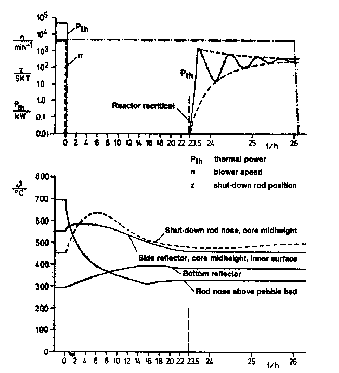
Demonstration of inherently safe AVR shutdown

The pebble bed reactor is an intrinsically safe because the chain reaction diminishes as the fuel temperature rises. This has been demonstrated. The experimental Arbeitsgemeinschaft Versuchsreaktor (AVR) was built in Germany in 1960. Dr. Rudolf Schulten was the originator of the pebble bed reactor design. The experimental AVR at the Julich Research Center operated at 46 megawatt thermal power, about 13 negawatt electric. The safety test was performed in 1970 by stopping the cooling and preventing the control rods from activating. The temperature rose, Doppler broadening absorbed neutrons in U238, the chain reaction slowed, temperatures fell, and the unit stabilized at 300 kilowatts.


HTR-300 Cooling Tower

Germany also built a second pebble bed reactor, the THTR-300, which generated 300 megawatts when it achieved full power operation in 1989. THTR stands for Thorium High Temperature Reactor; it uses thorium to enrich the uranium fuel. Thorium is fertile in that it is not itself very radioactive but can be transformed into uranium fuel. The Th232 absorbs a neutron from the chain reaction of U235 decay, and then the Th233 decays into U233, which is a fissile element that participates in the chain reaction. Thorium is three times as plentiful as uranium in the earth's crust.

In 1986 an operator error caused some of the pebbles to be fractured and the helium gas lock to be jammed. An unknown amount of radioactive materials were released. The THTR-300 was shut down in 1989 following public concerns arising from the Chernobyl accident. Since then Germany has decided to shut down all its nuclear power plants.

Friday, March 30, 2007

China has built a pebble bed reactor


HTR-10 at China's Tsinghua University

China's Tsinghua University has built a 10 MW research pebble bed reactor, achieving criticality in 2000. HTR-10 stands for High Temperature gas-cooled Reactor of 10 Megawatts heat output. It is cooled by helium gas. The helium gas today powers a steam generator. Currently the faculty and students are designing a power conversion unit to be driven directly by the hot helium. This unit will incorporate helium compressors and turbines with active magnetic bearings and a compact heat exchanger.

Tsinghua University and MIT collaborate on the development of this pebble bed reactor.

Australia exports uranium to China. The Australian Broadcasting Company recently interviewed Professor Zhang Zuoyi about the HTR-10 pebble bed reactor in China. During the visit the reactor helium cooling system was purposefully shut down to demonstrate the intrinsic, passive safety of the pebble bed reactor. You can see this on the video available on the ABC web site.


Demonstration plant for 19 pebble bed reactors

China has ambitious plans for pebble bed reactor nuclear power. According to MIT Professor Andrew Kadak China will build a 190 megawatt demonstration reactor power plant at Rongcheng. If successful, a total of 19 pebble bed reactors generating 3,600 megawatts will be constructed at that site.

China is not just waiting for pebble bed reactor nuclear power. China already operates 10 nuclear power reactors, with 7 under construction. Additionally China just signed a $6-7 billion contract with Westinghouse to build four AP-1000 advanced pressure water reactors generating 1,000 megawatts each. [This works out to $1,360 per kilowatt capital cost, below the design goal of the US NGNP project.] Westinghouse is a Pittsburgh company owned by Toshiba.

Shortly thereafter, China signed an agreement with France's Areva for two more nuclear power plants.

Sunday, March 25, 2007

South Africa is planning a Pebble Bed Reactor


PBMR vessel, turbines, and generator

The Pebble Bed Modular Reactor (PBMR) is the terminology for South Africa's specific pebble bed reactor project and company. Pebble Bed Modular Reactor (Pty) Ltd has designed and is building a single module demonstration pebble bed reactor with a capacity of 165 MW. Assuming regulatory approvals, the demonstration plant will begin construction in 2008 with the first fuel load scheduled for 2012. If successful, South Africa intends to produce PBMR units for internal use and for export to Africa and the rest of the world. South Africa is planning to use 20 to 30 165 MW units to meet its own power needs.

The PBMR would be useful in many emerging nations than cannot afford billion dollar 1,000 MW power plants common in the US. Because the PBMR is refueled while in operation without being shut down, it can be a single, reliable electric power source in isolated regions. Exporting PBMRs could be a significant income source for South Africa, which is contemplating exporting 10 units per year, perhaps selling in the $150-200 million range. PBMR Pty Ltd has already taken preliminary steps with the US Nuclear Regulatory Commission to license the PBMR for the US market.

Eskom, the South African utility company, began investigating pebble bed technology in 1993, obtaining a license for the technology first developed in Germany in 1966. Eskom was joined by other investors in 2000, including the Industrial Development Corporation of South Africa, British Nuclear Fuels (BNFL), and the US utility Exelon. Since then Exelon has dropped out and the BNFL role has been taken over by Westinghouse, which BNFL sold to Toshiba.

Progress is being made

Mitsubishi Heavy Industries has been awarded the contract for the basic design of the core barrel assembly of the reactor vessel. According to PBMR Ltd, Mitsubishi will be the integrator and single point supplier for the complete system.


Prototype helium turbine built in Potchefstroom

The gas turbine test rig was built by the engineering department of the University of Potchefstroom near Johannesburg. The main pressure vessel of the test rig is 17.5 meters long and weighs 12 tons. The test rig represents the first closed-cycle, multi-shaft gas turbine in the world.


Uranium fuel kernels production

Pelindaba Labs has created a process for producing the small kernels of UO2 that are the fuel for the PBMR.

Earthlife Africa opposes the PBMR and in 2005 persuaded the court to set aside the positive Record of Decision on the environmental impact study. In January 2007 the Department of Environmental Affairs permitted the project to go ahead with the pilot fuel plant at Pelindaba.

Helium test facility

The project has constructed a helium test facility at Pelindaba near Pretoria. It is to test the complete, high temperature, high-pressure helium cycle. The test facility will also simulate fuel-handling, reactivity control, and shut-down.

Summary

The design and planning of the PBMR demonstration reactor and pilot fuel plant are well underway. Funds have been made available. The fuel plant environmental impact statement has been accepted, but the EIA for the demonstration reactor and the nuclear licensing still have to be finalized. Fuel fabrication, helium testing, and turbine manufacturing are underway. Plans are that the demonstration reactor will start construction in 2008 and be operating in 2012.

Saturday, March 17, 2007

Idaho National Laboratory would build the first US PBR


INL Very High Temperature Reactor

In the hospital waiting room last week I was astonished to find the January 2, 1989, copy of Time magazine. Time described an "inherently safe...heat-resistant ceramic spheres...cooled by inert helium gas" reactor to be built by the US government in Idaho Falls. This pebble bed reactor project has been awaiting funding for at least 18 years.


The 1989 Time magazine also contained an article, Global Warming Feeling the Heat, quoting remarks by James Hansen, head of NASA's Goddard Institute for Space Studies, the first high level US scientist to emphasize the effect of society's CO2 emissions on climate.


It's taking us more than 18 years to face up to the facts that
  • our CO2 emissions contribute to global warming, and
  • nuclear power can reduce CO2 emissions.
Idaho National Laboratory

Idaho National Laboratory (INL) is situated on 890 square miles of the southeastern Idaho desert. Established in 1949, it has been the principal locus of research and testing of nuclear power systems in the US. The first nuclear reactor to produce electric power operated there in 1951. INL has designed and constructed 52 nuclear reactors, including breeder reactors, marine propulsion reactors, boiling water reactors, and a gas cooled reactor. INL employs approximately 8,000 scientists, engineers, technicians, and management personnel.

INL currently operates two nuclear reactors, including the Advanced Test Reactor, used to test materials for building future reactors. Materials can swell or become brittle after long periods of radiation. This reactor operates at such a high neutron flux that the effect of years of exposure in commercial reactors can be duplicated in weeks or months.


Pebble Bed Reactor Fuel

Together with Oak Ridge National Laboratory and BWXT, INL has been fabricating ceramic-encapsulated uranium fuel for the pebble bed reactor in 2006. Sample fuel cylindrical pellets were placed in the Advanced Test Reactor to test the materials in the high neutron flux. These fuel pellets will be removed and examined in 2008, having been exposed to the equivalent of many years of exposure within a pebble bed reactor. INL plans to test the complete fuel spheres as well.

US Energy Policy Act of 2005

The US Energy Policy Act of 2005 directs the establishment of a Next Generation Nuclear Plant to produce electricity, hydrogen, or both. INL is specified as the site of the nuclear reactor and associated plant. The Act authorizes $1.25 billion for the project, however the Congress has not yet appropriated this money.

Currently there are six candidate technologies under study at INL.
  • Gas Cooled Fast Reactor (GRF)
  • Very High Temperature Reactor (VHTR)
  • Supercritical Water Cooled Reactor (SCWR)
  • Sodium Cooled Fast Reactor (SFR)
  • Lead Cooled Fast Reactor (LCR)
  • MSR Molten Salt Reactor (MSR)
Nuclear Hydrogen Production

Hydrogen is a feedstock for the production of hydrocarbon vehicle fuels, such as H3COH (methanol) and H3COCH3 (dimethyl ether). Efficient production of hydrogen is possible with the high 900-950 C temperature of a very high temperature gas reactor, such as the pebble bed reactor. Two candidate hydrogen production technologies are the sulfur-iodine cycle and high-temperature electrolysis under study at INL.

The PBR is a prime candidate for the Generation IV prototype to be built at Idaho National Laboratories.

Sunday, March 11, 2007

Compare Coal Power to PBR Nuclear Power


Trainloads of coal power the US electric grid

A typical 1,000 megawatt coal fired electric plant burns a mile-long train of coal every day. Burning these 11,000 tons of carbon fuel creates 3.6 times as much carbon dioxide, because each C12 binds to two O16 atoms. If we were to capture all that carbon dioxide, refrigerate and liquefy it, it would fill a train of refrigerated tank cars over 3 1/2 miles long! Remember, this is for one day, for one power plant of at least 400 in the US. Clean coal advocates propose to sequester these liquids.


US Carbon Dioxide Source (US EPA)

Coal contributes the energy for half the electricity generated in the United States. It is relatively inexpensive and readily available, with centuries of supply available. However, coal is the largest source of carbon dioxide emissions into the atmosphere.


Proposed new US Coal Burning Electric Power Plants

A 2007 EPA study reveals that the electric power industry plans to build 159 new coal electric generation plants in the next years, to generate 96,000 megawatts of power at a construction cost of $141 billion. China is building one new coal fired power plant every week. China and the US seem to be vying to be the world's top CO2 emitter, with China projected to pass the US in the pollution race in 2009.

Coal is more than a source of electric power. Coal gasification can produce liquid transportation fuels, as SASOL is already doing in South Africa. China is to build 8 liquefaction plants by 2020, with output sufficient to displace 10% of China's oil imports. The process captures about half the energy from the coal. The rest is lost as heat with the release of carbon dioxide. In all, burning transportation fuel produced from coal releases twice the CO2 that using petroleum sourced fuels does.

Clean coal comes from sequestering carbon dioxide

The coal industry and environmentalists talk about carbon capture. The idea is to capture the carbon dioxide emitted from coal burning power plants and store it, sequestered from the environment. Two commonly proposed places to sequester the CO2 are under ground or under the sea. To pump more oil from depleted oil fields CO2 has successfully been pumped into the ground to force the oil out. But there are not nearly enough such places for all the CO2 the US currently emits. The place with enough room is the ocean. Liquefied CO2 could be pumped to the depths of the ocean, where it would remain liquid because of the immense water pressure miles below the surface. You can learn more at the EPA web site.

Sequestration is today only a promising future technology. No large scale sequestration is taking place. New technologies will be needed, because today's costs are too high -- $150 per ton of carbon. Compare this to the $40 per ton cost of the coal, and estimate the effect on electric power costs.

The United States Department of Energy did establish seven regional partnerships to explore sequestration. In October, 2007, DOE awarded $318 million for three demonstration projects to sequester CO2 underground.

Will the sequestered CO2 somehow leak back into the environment? In 1986 Lake Nyos in Cameroon was saturated with CO2 from volcanic sources. An unknown geological event overturned the supersaturated water at the bottom of the lake, bringing it to the surface where 1.6 million tons of CO2 effervesced into the atmosphere. The heavier-than-air gas suffocated over 1,000 people. Geologists say this will not happen with sea-sequestered CO2. The 1.6 million tons is about the amount of CO2 produced in about 40 days' operation of one large coal fired power plant.

Coal Integrated Gasification Combined Cycle can help

Combined cycle gas turbines have been successfully used in natural gas fired power plants. They generate power by burning fuel in a gas turbine engine, much like a jet aircraft engine. They also capture heat to make steam to generate additional power. Hence the name combined cycle. This technology is becoming applicable to the coal industry, too. The Integrated Gasification Combined Cycle (IGCC) plant may have an efficiency of 50-60%, compared to the typical 33% efficiency of today's coal plants. Sequestration advocates favor new IGCC plants because the carbon dioxide can be more economically captured. Of the 159 or so proposed new US coal plants, only 32 have been proposed. Only a handful are moving forward. None are in operation. The carbon capture technology has not been engineered and is not included in the plans. IGCC plants cost 10-15% more than pulverized coal plants.

But wouldn't IGCC plants be a good idea anyhow if they have 50% efficiency rather than 33%? We could make the same electricity with only 33/50 of the coal? They would reduce CO2 emissions by 33%.

Compare Coal Power to PBR Nuclear Power

Coal plants are the major source of carbon dioxide the US; nuclear plants do not emit CO2.

Clean, safe nuclear power exists; clean coal is a future technology. Carbon dioxide sequestration on the needed scale is an untested, emerging technology. Its safety needs proving. The expense would double the cost of electric power.

Per kilowatt hour produced, the death rate in the coal power industry is 40 times that of the nuclear power industry.

Coal has a role in industry. Coal or carbon dioxide from existing coal power plants can combine with hydrogen from high temperature gas pebble bed reactors to form vehicle fuels such as ethanol or methanol.

The website nuclearoil.com proposes a radical use for coal fired power plants -- replacing the boilers with nuclear reactors for heat.