Showing posts with label uranium. Show all posts

Saturday, April 12, 2008

UConn prof writes clear PBMR overview


Pelindaba, South Africa, pebble bed work site

Professor Lee Langston writes in Mechanical Engineering
University of Connecticut retired professor Lee Langston has just published a very clear, readable history of the pebble bed modular reactor project underway in South Africa. Pebbles Making Waves is the feature article in the April, 2008, issue of Mechanical Engineering, published by the American Society of Mechanical Engineers.

I encourage you to read this overview of the history and status of the Pebble Bed Modular Reactor project in South Africa.


Saturday, April 7, 2007

Germany built the first pebble bed reactor


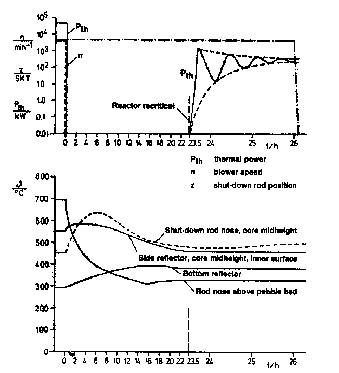
Demonstration of inherently safe AVR shutdown

The pebble bed reactor is an intrinsically safe because the chain reaction diminishes as the fuel temperature rises. This has been demonstrated. The experimental Arbeitsgemeinschaft Versuchsreaktor (AVR) was built in Germany in 1960. Dr. Rudolf Schulten was the originator of the pebble bed reactor design. The experimental AVR at the Julich Research Center operated at 46 megawatt thermal power, about 13 negawatt electric. The safety test was performed in 1970 by stopping the cooling and preventing the control rods from activating. The temperature rose, Doppler broadening absorbed neutrons in U238, the chain reaction slowed, temperatures fell, and the unit stabilized at 300 kilowatts.


HTR-300 Cooling Tower

Germany also built a second pebble bed reactor, the THTR-300, which generated 300 megawatts when it achieved full power operation in 1989. THTR stands for Thorium High Temperature Reactor; it uses thorium to enrich the uranium fuel. Thorium is fertile in that it is not itself very radioactive but can be transformed into uranium fuel. The Th232 absorbs a neutron from the chain reaction of U235 decay, and then the Th233 decays into U233, which is a fissile element that participates in the chain reaction. Thorium is three times as plentiful as uranium in the earth's crust.

In 1986 an operator error caused some of the pebbles to be fractured and the helium gas lock to be jammed. An unknown amount of radioactive materials were released. The THTR-300 was shut down in 1989 following public concerns arising from the Chernobyl accident. Since then Germany has decided to shut down all its nuclear power plants.

Sunday, March 25, 2007

South Africa is planning a Pebble Bed Reactor


PBMR vessel, turbines, and generator

The Pebble Bed Modular Reactor (PBMR) is the terminology for South Africa's specific pebble bed reactor project and company. Pebble Bed Modular Reactor (Pty) Ltd has designed and is building a single module demonstration pebble bed reactor with a capacity of 165 MW. Assuming regulatory approvals, the demonstration plant will begin construction in 2008 with the first fuel load scheduled for 2012. If successful, South Africa intends to produce PBMR units for internal use and for export to Africa and the rest of the world. South Africa is planning to use 20 to 30 165 MW units to meet its own power needs.

The PBMR would be useful in many emerging nations than cannot afford billion dollar 1,000 MW power plants common in the US. Because the PBMR is refueled while in operation without being shut down, it can be a single, reliable electric power source in isolated regions. Exporting PBMRs could be a significant income source for South Africa, which is contemplating exporting 10 units per year, perhaps selling in the $150-200 million range. PBMR Pty Ltd has already taken preliminary steps with the US Nuclear Regulatory Commission to license the PBMR for the US market.

Eskom, the South African utility company, began investigating pebble bed technology in 1993, obtaining a license for the technology first developed in Germany in 1966. Eskom was joined by other investors in 2000, including the Industrial Development Corporation of South Africa, British Nuclear Fuels (BNFL), and the US utility Exelon. Since then Exelon has dropped out and the BNFL role has been taken over by Westinghouse, which BNFL sold to Toshiba.

Progress is being made

Mitsubishi Heavy Industries has been awarded the contract for the basic design of the core barrel assembly of the reactor vessel. According to PBMR Ltd, Mitsubishi will be the integrator and single point supplier for the complete system.


Prototype helium turbine built in Potchefstroom

The gas turbine test rig was built by the engineering department of the University of Potchefstroom near Johannesburg. The main pressure vessel of the test rig is 17.5 meters long and weighs 12 tons. The test rig represents the first closed-cycle, multi-shaft gas turbine in the world.


Uranium fuel kernels production

Pelindaba Labs has created a process for producing the small kernels of UO2 that are the fuel for the PBMR.

Earthlife Africa opposes the PBMR and in 2005 persuaded the court to set aside the positive Record of Decision on the environmental impact study. In January 2007 the Department of Environmental Affairs permitted the project to go ahead with the pilot fuel plant at Pelindaba.

Helium test facility

The project has constructed a helium test facility at Pelindaba near Pretoria. It is to test the complete, high temperature, high-pressure helium cycle. The test facility will also simulate fuel-handling, reactivity control, and shut-down.

Summary

The design and planning of the PBMR demonstration reactor and pilot fuel plant are well underway. Funds have been made available. The fuel plant environmental impact statement has been accepted, but the EIA for the demonstration reactor and the nuclear licensing still have to be finalized. Fuel fabrication, helium testing, and turbine manufacturing are underway. Plans are that the demonstration reactor will start construction in 2008 and be operating in 2012.

Wednesday, January 3, 2007

Pebbles contain the products of radioactive decay


Pebbles contain thousands of coated particles of UO2

Each fuel sphere, or "pebble" is a bit smaller than a tennis ball and contains many small particles of uranium oxide, which is the fuel for the nuclear reactor. Each fuel particle is wrapped in several layers of ceramic carbon and silicon carbide. The first layer of porous pyrolytic graphite absorbs the radioactive xenon gas emitted when the uranium splits. Next is a containment wrapping of high density nonporous pyrolytic carbon, a layer of fireproof silicon carbide, further contained by a layer of pyrolytic carbon. About 15,000 of the coated fuel particles are embedded in a graphite matrix that forms the fuel sphere, which is surfaced with a layer of pyrolytic graphite.

The carbon in the pebbles also acts as a moderator for the nuclear reaction. Carbon slows down U235 decay neutrons that bounce off the carbon atoms so that the slowed neutrons have a good chance of splitting another U235 atom.

A designed effect of these multiple layers is to contain the products of radioactive decay within the pebbles themselves. The pebbled radioactive waste can be safely disposed of in geological storage.

The carbides and pyrolytic carbon materials in the pebbles all maintain strength at temperatures well above the reactor's possible temperatures. The presence of carbon within the reactor should not lead to concerns that a fire would lead to a Chernobyl-like disaster. Pyrolytic carbon will not burn at temperatures as high as 2000 degrees C, well above the maximum possible 1650 degree temperature of a worst case criticality excursion. In any case, the UO2 is contained within a sealed silicon carbide firestop. The inherent safety of the pebble bed reactor is key to public acceptance of widespread use of the technology, so further research and experimentation will be an important confirming activity.

Wikipedia and MIT web sites have more information.